
Choose Your Fighter: Scalper, Swing Trader, Trend Follower, or Position Trader?
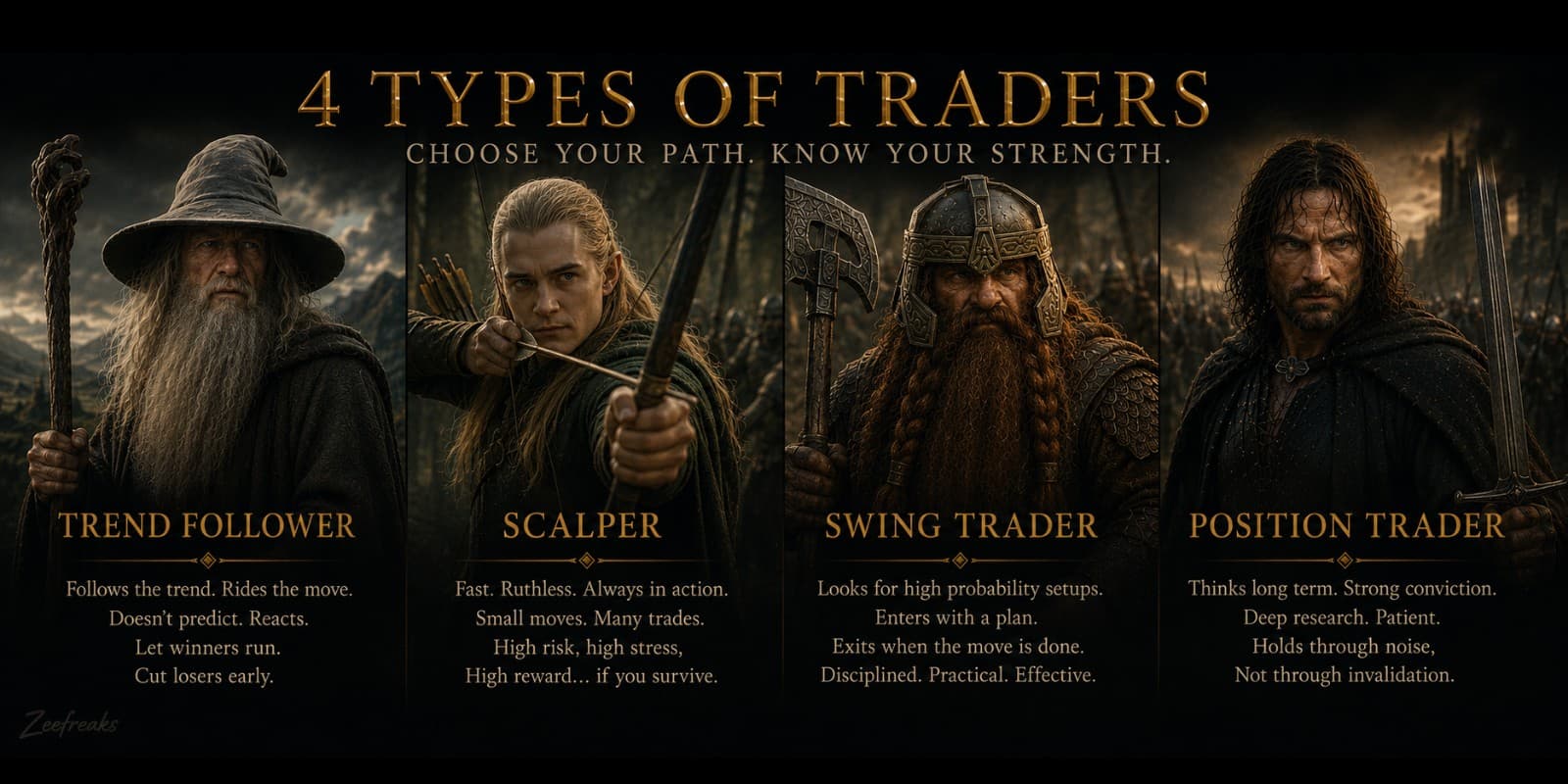
There is no “best” trading style.
There is only the style that fits your schedule, personality, capital, and ability to follow rules without suddenly turning a failed trade into a long-term investment.
A profitable strategy can still be useless if it does not fit your life.
If your system requires you to stare at charts the whole day, but you have a full-time job, three meetings, two kids, and a boss who keeps asking why TradingView is open, good luck.
So before copying someone else’s trades, know what type of trader you actually are.
Here are the four common classes.
1. The Scalper
Also known as: The Adrenaline Junkie
Scalpers hold trades for seconds or minutes.
Their goal is simple: take a small move, get paid, and get out before the market changes its mind.
They are not asking:
“Where will this stock be next year?”
They are asking:
“Can I make money from this move before lunch?”
Scalping sounds exciting because there are always opportunities. You can trade multiple times in one session and get immediate feedback.
Unfortunately, the market also gives immediate feedback when you are wrong.
Scalping requires:
Fast decision-making
Tight risk management
Good execution
High concentration
The ability to cut quickly without holding a farewell ceremony
Since the profit target per trade is usually small, spreads, fees, slippage, and bad entries matter a lot.
The biggest danger is overtrading.
After three wins, you feel unstoppable.
After three losses, you want revenge.
After ten trades, you forget why you opened the chart in the first place.
Scalping may fit you if:
You enjoy fast-paced decisions, can focus for long periods, and have no problem taking small losses repeatedly.
Biggest trap:
A scalp goes against you, so you decide to “give it more room.”
Five minutes later, it becomes a swing trade.
Two days later, it becomes a position trade.
One month later:
“Strong fundamentals naman.”
Scalper’s rule:
Take the trade. Take the loss. Take the profit. Do not take it personally.
2. The Swing Trader
Also known as: The Hunter
Swing traders normally hold positions for a few days to several weeks.
They are looking for a meaningful price move—not every tiny candle, but not the entire multi-year trend either.
Common swing setups include:
Breakouts
Pullbacks
Reversals
Momentum plays
Catalyst-driven moves
Continuation patterns
The swing trader’s job is to wait for a good setup, enter with a clear plan, then sell when the move has played out.
You do not need to catch the exact bottom.
You do not need to sell the exact top.
Actually, trying to do both is usually how people end up catching neither.
Swing trading is practical for people who cannot watch the market all day. You can review charts after work, set alerts, plan entries, and manage positions without reacting to every five-minute candle.
The trade-off is overnight risk.
A beautiful chart at market close can wake up the next day looking like it went through something traumatic.
News, earnings, market gaps, and sudden events can move the price before you even open your broker.
Swing trading may fit you if:
You enjoy studying setups, can check the market regularly, and prefer holding for days rather than minutes.
Biggest trap:
Changing your timeframe because the trade is losing.
Your original plan was:
“Breakout trade. Cut if support fails.”
Support fails.
Suddenly:
“Actually, I believe in the company long term.”
No. You just do not want to cut.
Swing Trader’s rule:
Know your entry, target, and invalidation before you click buy.
A swing trade should have an expiry date.
3. The Trend Follower
Also known as: The Surfer
Trend followers do not try to predict every top and bottom.
They wait for a trend to appear, enter when there is enough confirmation, and stay in the trade until the trend breaks.
The philosophy is simple:
“I do not need to be first. I just need to be right long enough.”
Trend followers may use:
Breakouts
Moving averages
Higher highs and higher lows
Trailing stops
Momentum indicators
Price structure
Unlike scalping, swing trading, and position trading, trend following is not strictly based on holding period.
You can follow a trend for several days or several months. What matters is that you remain in the trade while the trend is intact.
Trend followers usually enter late.
They also exit late.
They do not buy the bottom because there is no confirmed trend yet. They may also sell below the peak because they need evidence that the trend has ended.
This annoys people who love perfect screenshots.
But perfect entries and exits are usually visible only after the chart is finished.
In real time, the market does not provide subtitles.
The biggest challenge in trend following is patience.
You need to survive:
False breakouts
Sideways markets
Several small losses
Normal pullbacks
The urge to sell too early
Many traders claim they want to ride trends.
But once the position is up 10%, they panic and take profit.
Then they watch it go up another 80% without them.
Trend following often works because a few large winners can pay for many small failed trades. But that only happens if you actually allow the winners to run.
Trend following may fit you if:
You like clear rules, do not want to predict tops and bottoms, and can tolerate several small losses while waiting for one big trend.
Biggest trap:
Cutting winners early and giving losers “more time.”
Basically, doing the exact opposite of the system.
Trend Follower’s rule:
Cut the failed trends. Stay with the real ones.
You will never capture the whole move.
Okay lang.
The middle is usually where the money is anyway.
4. The Position Trader
Also known as: The Strategist
Position traders hold for weeks, months, or sometimes years.
They are not interested in every short-term fluctuation. They are focused on a larger thesis.
That thesis may involve:
A company entering a growth cycle
An industry recovering
A long-term breakout
A major technology trend
Changes in supply and demand
Macroeconomic conditions
Earnings growth
Valuation
A position trader may combine technical and fundamental analysis.
For example:
“I like the company’s long-term growth, the industry is improving, and the chart is finally breaking out.”
This is very different from:
“I bought because someone on Telegram said it could 10x.”
Position trading requires less daily screen time, but more research and patience.
You need to tolerate normal volatility without panicking every time the stock drops 3%.
At the same time, “long term” should not become an excuse to ignore a broken thesis.
There is a difference between holding through noise and holding through disaster because you became emotionally attached.
Position trading may fit you if:
You enjoy research, prefer fewer high-conviction trades, and can wait months for an idea to develop.
Biggest trap:
Confusing conviction with stubbornness.
A thesis can be wrong.
A company can deteriorate.
An industry can change.
Management can disappoint.
The market does not care how many hours you spent researching.
Position Trader’s rule:
Hold through noise, not through invalidation.
Patience is a strength.
Blind loyalty is not.
Same Stock, Different Traders
Let us say a stock breaks out at ₱100 and eventually reaches ₱150.
The scalper buys at ₱100.50 and sells at ₱101.50.
The swing trader enters at ₱105 and exits at ₱120.
The trend follower enters after confirmation and stays until the trend breaks at ₱138.
The position trader may have accumulated below ₱100 based on a bigger thesis and holds for several months.
All of them can make money.
All of them can also lose money.
The difference is not the stock.
The difference is the plan.
Can You Be More Than One?
Of course.
You can have:
A long-term portfolio
A separate swing-trading account
A trend-following system
A small account for short-term trades
The problem starts when you mix strategies inside one position. I personally have different accounts for different strategies.
Do not enter as a scalper, get trapped as a swing trader, then defend the position like a long-term investor.
Before entering, label the trade:
SCALP. SWING. TREND. POSITION.
Then answer five questions:
Why am I entering?
Where am I wrong?
How much am I risking?
How long do I expect to hold?
What will make me exit?
If you cannot answer those before entering, you are not trading.
You are just clicking buttons with financial consequences.
So, Which One Is Best?
The best style is the one you can execute consistently.
A disciplined scalper is better than an impulsive position trader.
A patient trend follower is better than a swing trader who changes plans every candle.
A position trader with a clear thesis is better than someone who calls every losing stock an “investment.”
Your strategy should fit your real personality—not the personality you imagine you have after watching three trading videos.
If you hate waiting, position trading may drive you crazy.
If you panic during fast markets, scalping may destroy you.
If you keep taking profits too early, trend following will frustrate you.
If you cannot hold overnight, swing trading may not be for you.
Know your class.
Know its strengths.
More importantly, know its weaknesses.
Because in the end, profitability is not about finding the perfect trading style.
It is about finding a style you can follow without becoming your own biggest problem.
Choose your fighter wisely.
And please... stop turning every failed trade into a long-term investment.
For educational purposes only. Not financial advice. The market is already dangerous enough without blaming a blog post for your entries.