
HOW MUCH CAPITAL DO YOU NEED TO BE A PART TIME INVESTOR IN CRYPTO MAKING ₱25K, ₱50K, OR ₱100K A MONTH IN PASSIVE INCOME?

Let us start with the most important sentence:
Passive income does not mean guaranteed income.
It simply means your capital is doing more of the work than you are.
The risk is still awake, even while you are sleeping. Sometimes crypto wakes up at 3:00 a.m. and chooses violence.
One of the biggest mistakes people make is putting everything into whichever product is showing the highest APY, which is basically an active anxiety subscription with a dashboard.
The goal here is to build a portfolio that can produce decent cash flow without requiring you to stare at charts all day, refresh your wallet every seven minutes, or feel your soul leave your body whenever Bitcoin drops 5%.
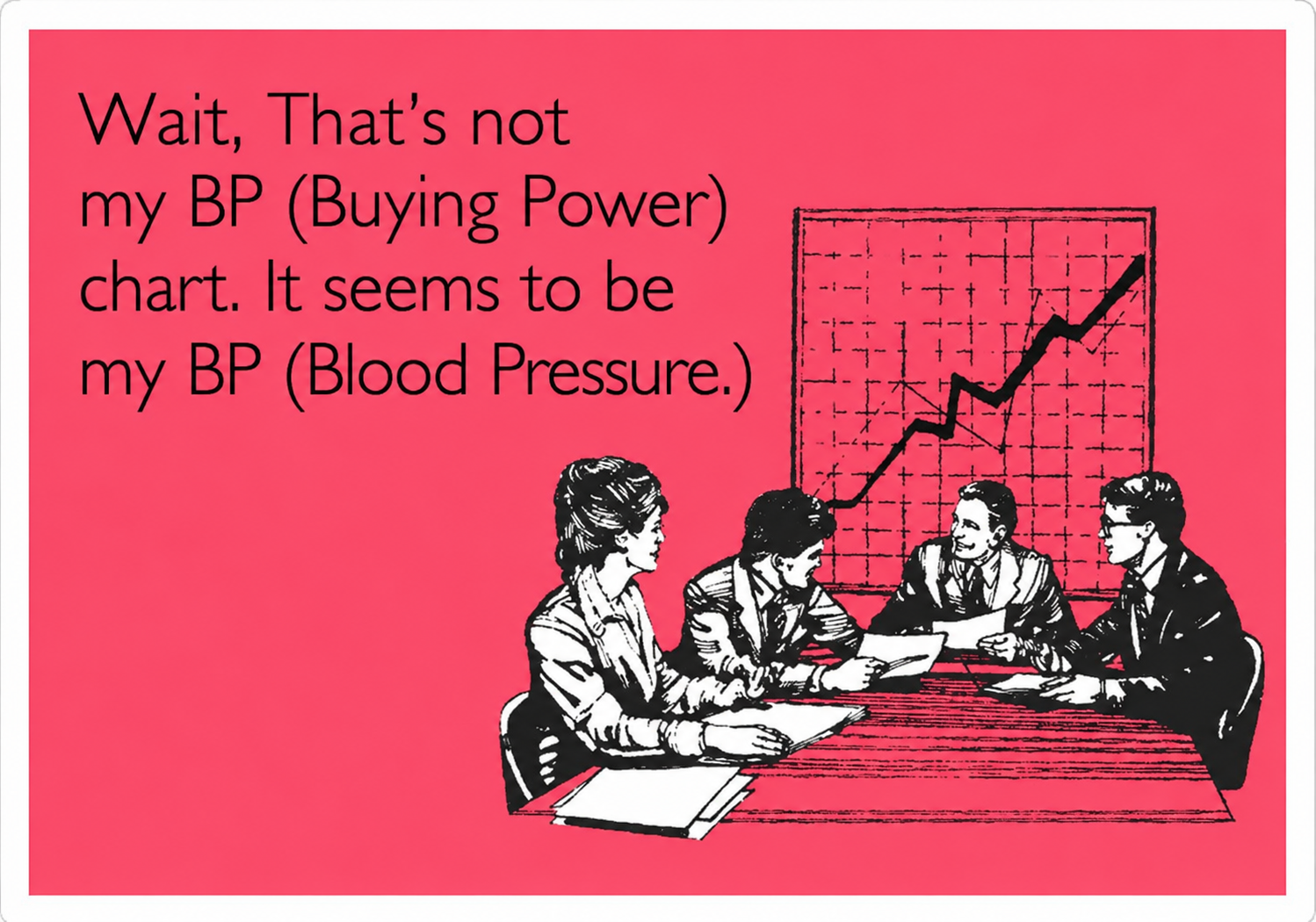
Your blood pressure should not be the highest yielding asset in your portfolio.
A Simple Mixed Risk Strategy
Here is a basic template:
60% in lower-risk products
This can include lending and similar yield products.
For this example, let us assume these products earn somewhere between 5% and 15% annually. To keep our projections reasonable, we will use 10% as our planning assumption.
This is the boring part of the portfolio.
And boring is good.
Boring pays bills. Boring lets you sleep. Boring does not suddenly announce that the developers have disappeared to an undisclosed island.
But remember, “low risk” means lower risk compared with other crypto products. It does not mean zero risk.
40% in mid to high-risk products
This can include:
Grid bots
Liquidity pools
Staking
Major crypto assets
Established protocols
Traditional finance products running on crypto rails
This side of the portfolio normally produces the larger yield, but it will also have more ups and downs.
For our example, let us use a 15% annual yield for this portion.
The idea is to use products and assets that have already survived several market cycles, have real liquidity, and have a relatively low chance of suddenly becoming a Netflix documentary.

Here Is the Math
If 60% earns 10%:
60% × 10% = 6%
If 40% earns 15%:
40% × 15% = 6%
Combined:
6% + 6% = 12% annualized portfolio yield
What is interesting here is that the lower-risk bucket holds more of your capital, but both sides contribute roughly the same amount of income.
The lower risk side gives you stability.
The mid to high-risk side gives you growth.
One keeps the boat floating. The other makes it move.
"Ok Zee, too many calculations, give me actual numbers"
So How Much Capital Do You Need?

Using a true 12% APY, the equivalent monthly return is approximately 0.949%.
Why use 12%?
Because it is not a random number pulled out of a crypto influencer’s thumbnail. It is a practical, bear-market-tested rate that I consider achievable and sustainable with the right mix of products and proper risk management. (Trust me, I'm betting my capital on it!)
As the market moves into the next cycle, opportunities for higher yields may appear. But higher yields usually come with higher risk, so for planning purposes, 12% is a solid and sensible baseline.
Anything above that is a bonus, not something your monthly budget should depend on.
That gives us the following numbers:
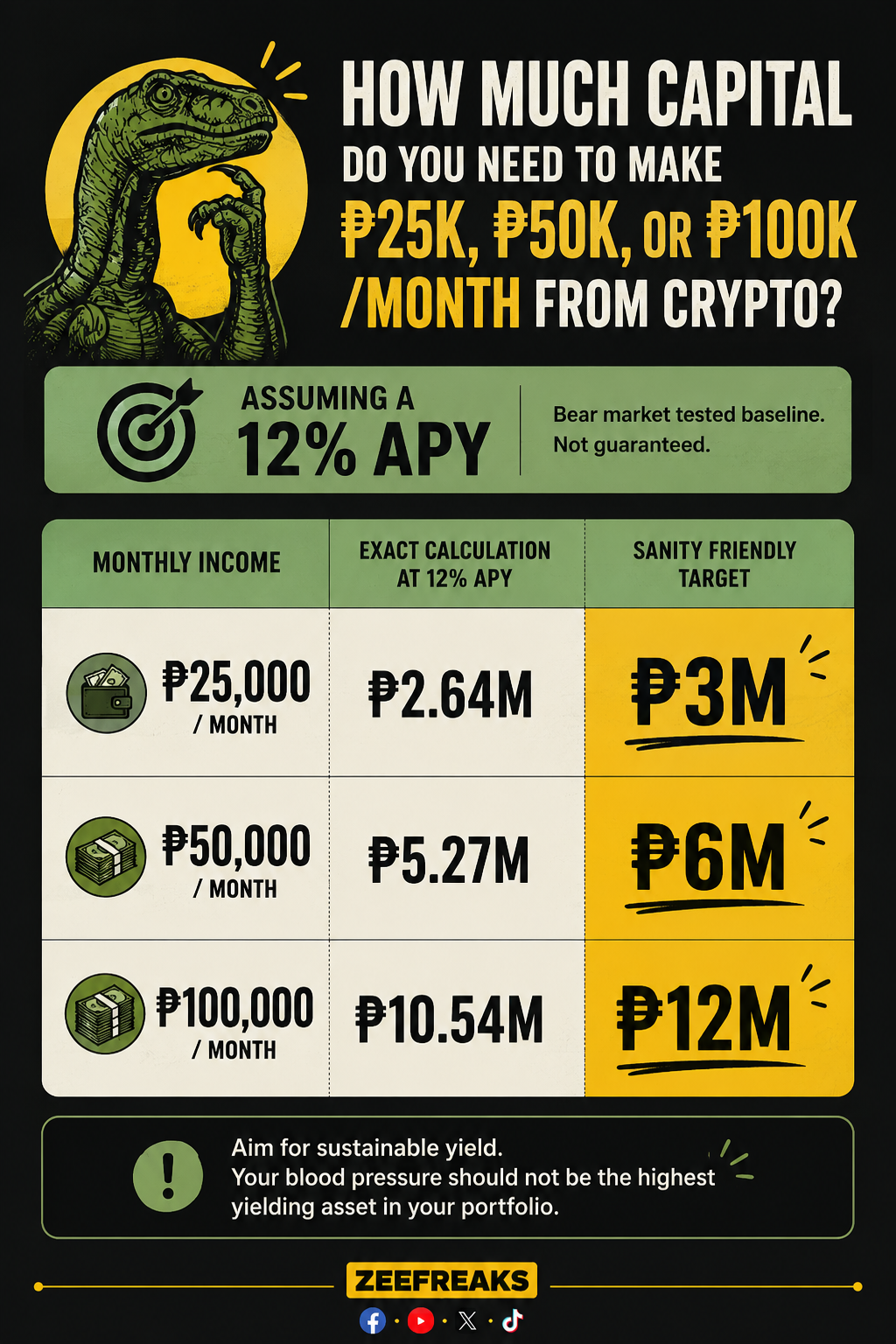
To make ₱25,000 per month
Annual income target: ₱300,000
Estimated capital required at 12% APY:
Approximately ₱2.64 million
For a more realistic buffer:
Aim for around ₱3 million
To make ₱50,000 per month
Annual income target: ₱600,000
Estimated capital required at 12% APY:
Approximately ₱5.27 million
For a more realistic buffer:
Aim for around ₱6 million
To make ₱100,000 per month
Annual income target: ₱1.2 million
Estimated capital required at 12% APY:
Approximately ₱10.54 million
For a more realistic buffer:
Aim for around ₱12 million
Here's a summary infographic of everything you need to know:
Why add a buffer?
Because yields change.
There will be slow months. Some capital may sit idle. There will be positions going out of range, token price movements, and the occasional market tantrum.
The spreadsheet may tell you that ₱10.54 million is enough.
Your sanity may prefer ₱12 million.
Why Not Put Everything Into Higher Yield Products?
Technically, you could use less capital by targeting a higher yield.
At 20% annually, ₱100,000 a month would theoretically require only ₱6 million.
At 30%, it would theoretically require ₱4 million.
At 100%, it would theoretically require ₱1.2 million.
And theoretically, I could become six feet tall by standing on my toes.
The question is not only:
“How much can this product earn?”
The more important questions are:
Where is the yield coming from?
What happens when the market falls?
What happens if one of the assets loses its peg?
What happens if the smart contract is exploited?
What happens when incentives disappear?
What happens when everyone tries to withdraw at the same time?
The higher the yield, the more questions you should ask.
Never let a large APY distract you from a small exit door.
My Personal Allocation
Personally, I allocate more than the sample 40% into mid to high-risk products, particularly liquidity pools.
Here’s an actual screenshot from one of my LP portfolios, with the assets and their price ranges hidden for obvious reasons. This is where the numbers are coming from, so we are working with real portfolio data, and not some theoretical crypto fairy dust.
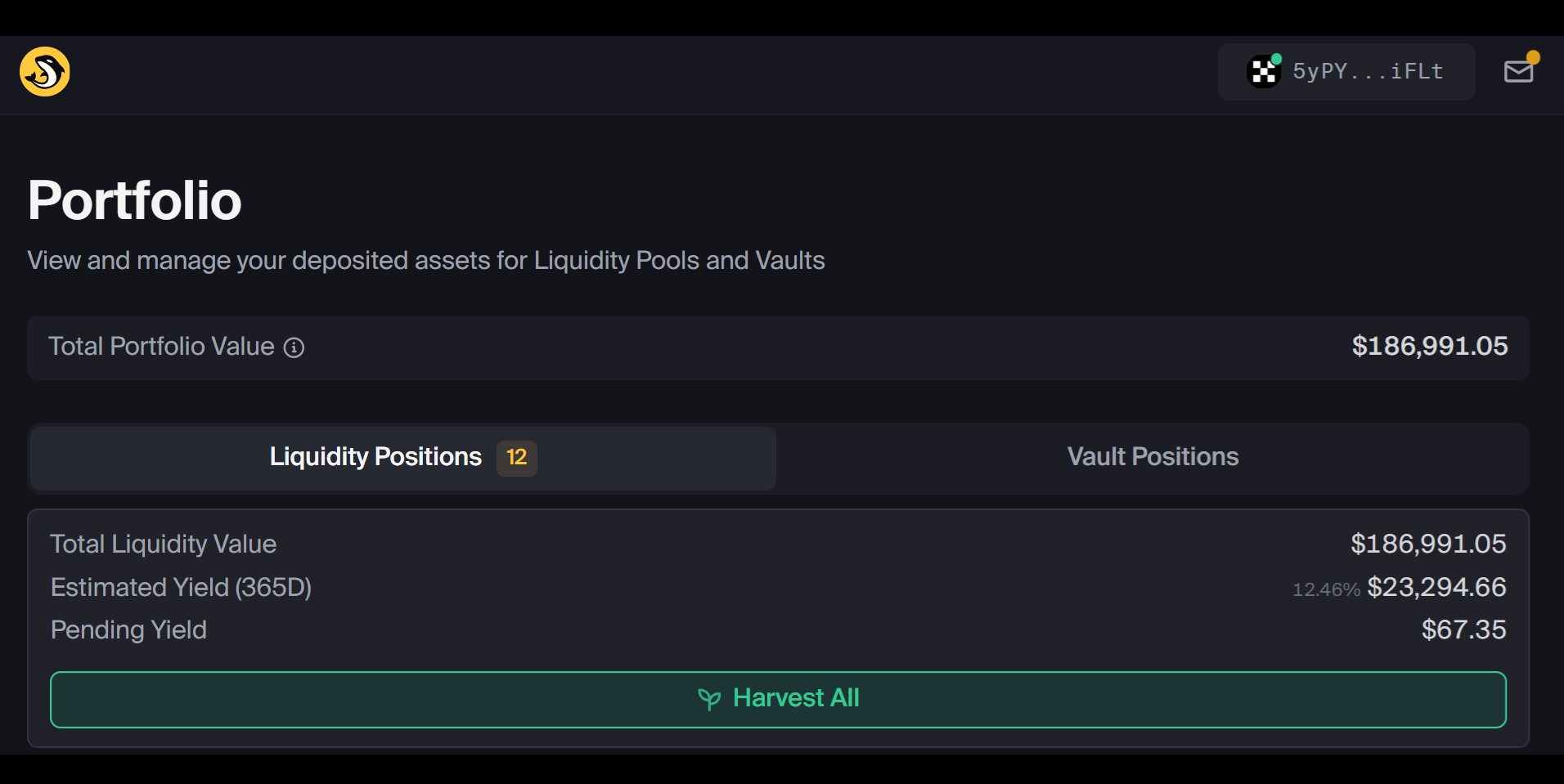
Platform Used: Orca
Network: Solana
I do this strategically by selecting assets, protocols, pairs, ranges, and position sizes that help reduce my overall risk while still allowing me to enjoy monthly yields.
My objective is also different.
I am currently more focused on portfolio growth than pure capital preservation.
That does not mean my allocation is automatically suitable for everyone.
Different people have different goals, timelines, experience levels, and abilities to tolerate volatility.
Some people can watch a position fall 20% and calmly review the data.
Other people see a red candle and immediately start negotiating with God.
Know which one you are.
A Real Portfolio Example
One of the portfolios you see in the example above is currently valued at around ₱11.5 million.
At a simple 12% annualized run rate, the math looks like this:
₱11.5 million × 12% = ₱1.38 million per year
₱1.38 million ÷ 12 = ₱115,000 per month
During stronger periods, the monthly yield can reach around ₱150,000. On an ₱11.5 million portfolio, that works out to an annualized run rate of approximately 15.7%.
But as I mentioned earlier, none of this is fixed.
It is not a salary.
Crypto does not send you an employment contract promising ₱115,000 every 30 days, complete with an HMO and Christmas bonus.
Some months will be better. Some months will be slower. The value of the portfolio itself will also move with the market.
What matters to me is whether the strategy can continue producing reasonable cash flow across different market conditions without requiring me to constantly babysit it.
This particular setup is already relatively low risk by crypto standards.
And those last three words are important.
Because “low risk” in crypto does not mean risk free.
The Golden Goose Strategy
Think of your capital as the golden goose.
The yield is the egg.
You can collect the eggs and use them as monthly income.
You can reinvest the eggs and grow the goose or your goose collection.
Or you can do a combination of both.
Unlike traditional dividends, where the company normally decides when distributions happen, most onchain products allow you to decide when to claim your available rewards.
That gives you more control over your cash flow and compounding.
But remember:
Every peso you withdraw is a peso that is no longer compounding.
If you spend every egg, the goose stays roughly the same size.
If you reinvest some of the eggs, the goose can become larger and potentially produce more eggs later.
Just do not cook the goose while chasing 100% APY.

The Practical Answer
For a mixed portfolio targeting around 12% annually:
₱25,000 monthly income:
Calculator answer: approximately ₱2.64 million
Sanity friendly target: approximately ₱3 million
₱50,000 monthly income:
Calculator answer: approximately ₱5.27 million
Sanity friendly target: approximately ₱6 million
₱100,000 monthly income:
Calculator answer: approximately ₱10.54 million
Sanity friendly target: approximately ₱12 million
Could you do it with less capital?
Yes.
But you would normally need to accept more risk, more volatility, more active management, or all three.
The objective is not to build the portfolio with the highest possible APY, but to build one that produces cash flow, grows across market cycles, and still allows you to go outside and do actual human activities.
Because if your “passive income” requires you to watch your positions fourteen hours a day, congratulations.
You have created a full-time job with no medical benefits.
This is not financial magic. It is just a framework for thinking about risk, yield, and capital. Know where your returns are coming from, know what can go wrong, and never invest money meant for rent, tuition, groceries, or anything else your real life considers non negotiable. Crypto does not care about your due dates.
Kind Regards,
Zeefreaks