
There Is No Such Thing as "No-Risk"
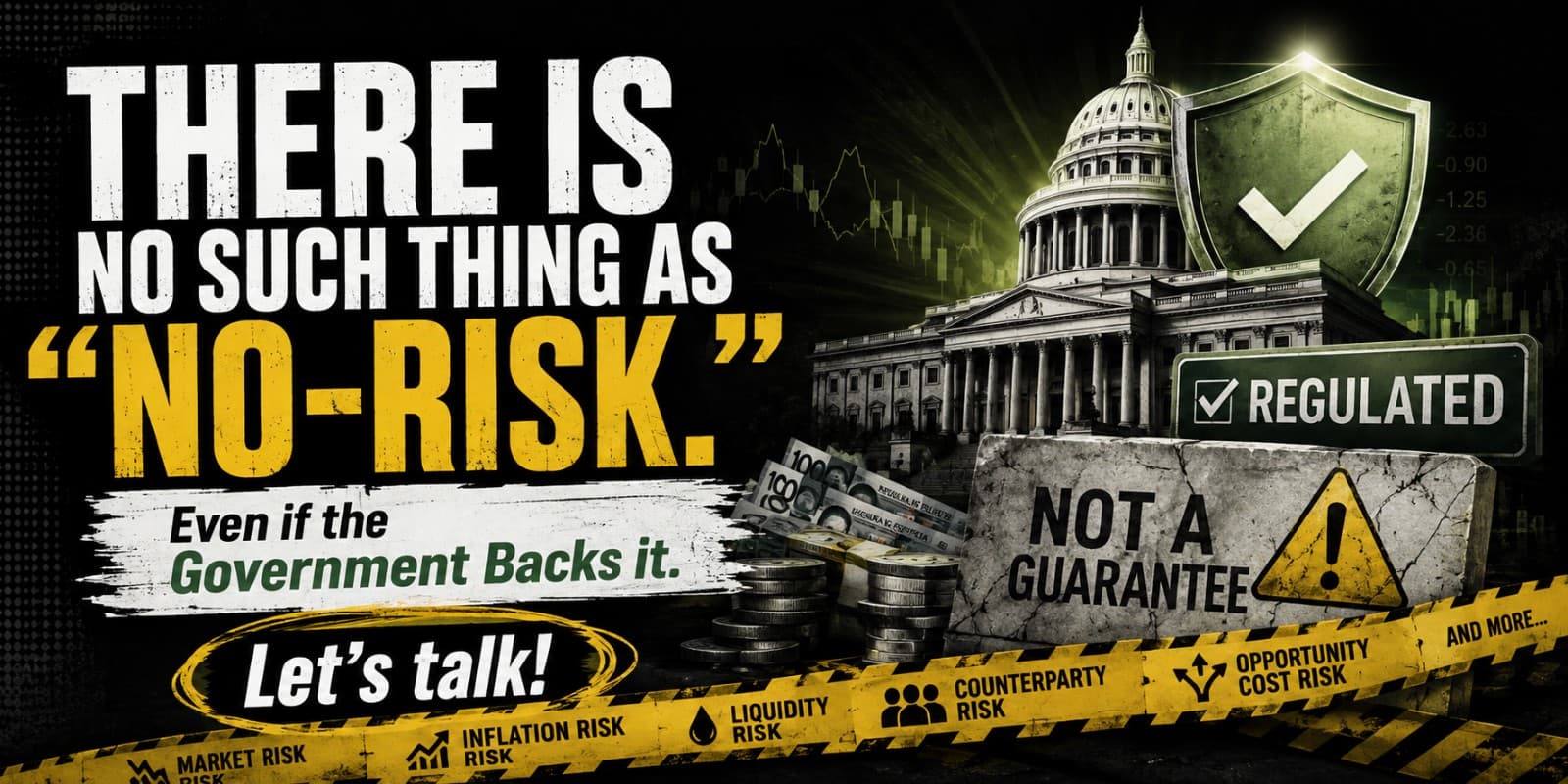
“SAFE BECAUSE IT’S GOVERNMENT-REGULATED.”
I hear this argument a lot.
And I think we need to kill one dangerous misconception:
Government-regulated does NOT mean government-guaranteed.
And even government-guaranteed does not automatically mean risk-free.
Those are three very different things.
Think of it this way:
A casino can be regulated by the government.
That does not suddenly turn the slot machines into a high-yield investment account.
Regulation ≠ Protection From Loss
When something is regulated, the government is basically saying:
“There are rules governing how this business/product operates.”
It does not necessarily mean:
“If you lose money, we'll give it back.”
In fact, even the BSP's own Verifier says that being registered with or supervised by BSP does not guarantee safety or assess an institution's financial soundness or risk.
Same thing with the SEC.
A company having SEC registration doesn't automatically mean its investments are safe or even that it's authorized to solicit investments. The SEC explicitly warns that basic corporate registration only gives the company legal personality; it doesn't automatically authorize every financial activity.
So when somebody tells you:
“Don't worry, regulated naman yan.”
My next question is:
“Okay. Regulated against WHAT risk?”
Because there isn't just one kind of risk.
Allow me to Introduce to you THE RISK LADDER.
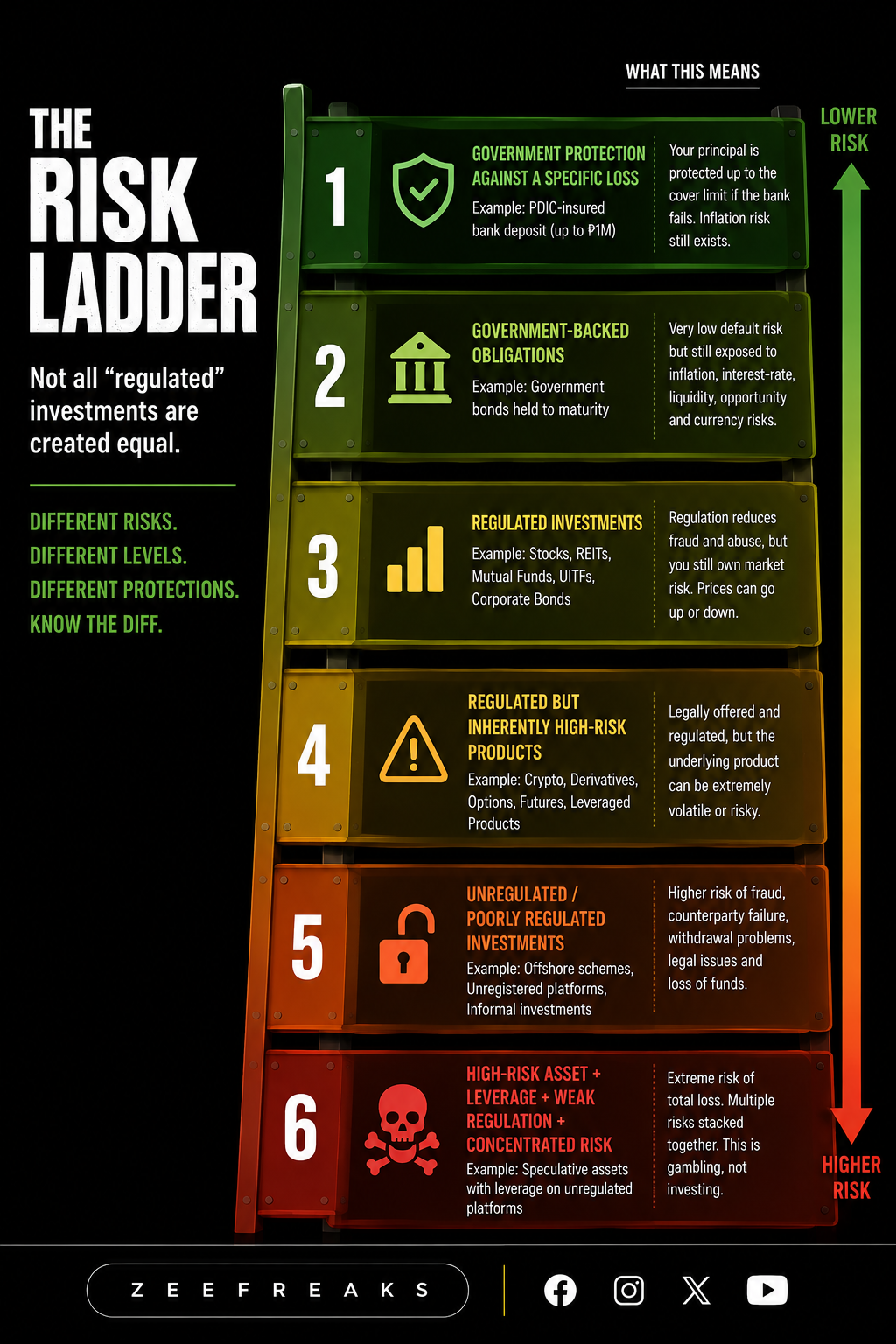
This is how I personally prefer explaining it.
LEVEL 1: Government protection against a SPECIFIC loss
Example: a valid bank deposit covered by PDIC.
As of 2026, PDIC covers eligible deposits up to ₱1 million per depositor, per bank if the bank fails.
That's real financial protection.
But even here, you're not magically immune from everything.
You still have:
Inflation risk.
Put ₱1 million somewhere earning 1% while inflation averages 4%, and congratulations:
Your account balance is safe.
Your purchasing power is slowly being eaten alive. 😂
So:
Principal risk: very low within insured limits
Inflation risk: still exists
LEVEL 2: Government-backed obligations
Think government securities held to maturity.
Here, instead of some private company promising to repay you, the sovereign government is the borrower.
Generally, that means very low credit/default risk, especially for local-currency obligations of a functioning government.
But again:
Low risk ≠ no risk.
You can still have:
• inflation risk
• interest-rate risk
• liquidity risk
• opportunity cost
• currency risk if you're investing in another currency
Buy a long-term government bond yielding 4%, then market rates suddenly become 7%?
Your bond can fall in market value.
The government didn't scam you.
It's just the Economy doing Economy things.
LEVEL 3: Regulated investments
Now we enter things like:
Stocks.
REITs.
Mutual funds.
UITFs.
Corporate bonds.
These can operate inside a heavily regulated financial system.
But the regulator isn't promising your money back.
If you buy a perfectly legitimate regulated stock at ₱100 and it falls to ₱50...
You can't walk into the SEC and say:
“Boss, registered naman sila. Refund please.”
😂
Regulation can reduce things like:
fraud risk, disclosure problems, abusive practices and illegal conduct.
But you still own:
market risk.
And that's a completely different animal.

LEVEL 4: Regulated but inherently high-risk products
This is where people really get confused.
Something can be legally offered and properly regulated while still being extremely risky.
Crypto is a perfect example.
A crypto service provider could satisfy regulatory requirements.
Fantastic.
That tells me something about the provider.
It tells me almost nothing about whether the token I'm buying will go:
+300%
or
-92%.
Same with derivatives.
Options.
Futures.
Leveraged products.
You can trade them on the most regulated financial institution on planet Earth.
Leverage will still liquidate you with absolutely no concern for your feelings.
Regulation doesn't change the mathematics of the investment.
LEVEL 5: Unregulated / poorly regulated investments
Now we're stacking risks.
You have the original investment risk...
PLUS:
counterparty risk
custody risk
fraud risk
legal risk
operational risk
withdrawal risk
That's why I don't automatically say:
“Unregulated = Scam.”
That's intellectually lazy too.
But lack of regulation means you're removing one layer of protection.
And every layer you remove deserves additional scrutiny.
LEVEL 6: High-risk asset + leverage + weak regulation + concentrated counterparty
This is where you combine:
A speculative asset.
On an obscure platform.
With leverage.
With no insurance.
With weak custody.
And your entire portfolio sitting there.
At this point you're no longer investing.
You're assembling the Infinity Guantlet of financial risk.

Risk isn't a single slider that goes:
SAFE ← ← ← → → → DANGEROUS
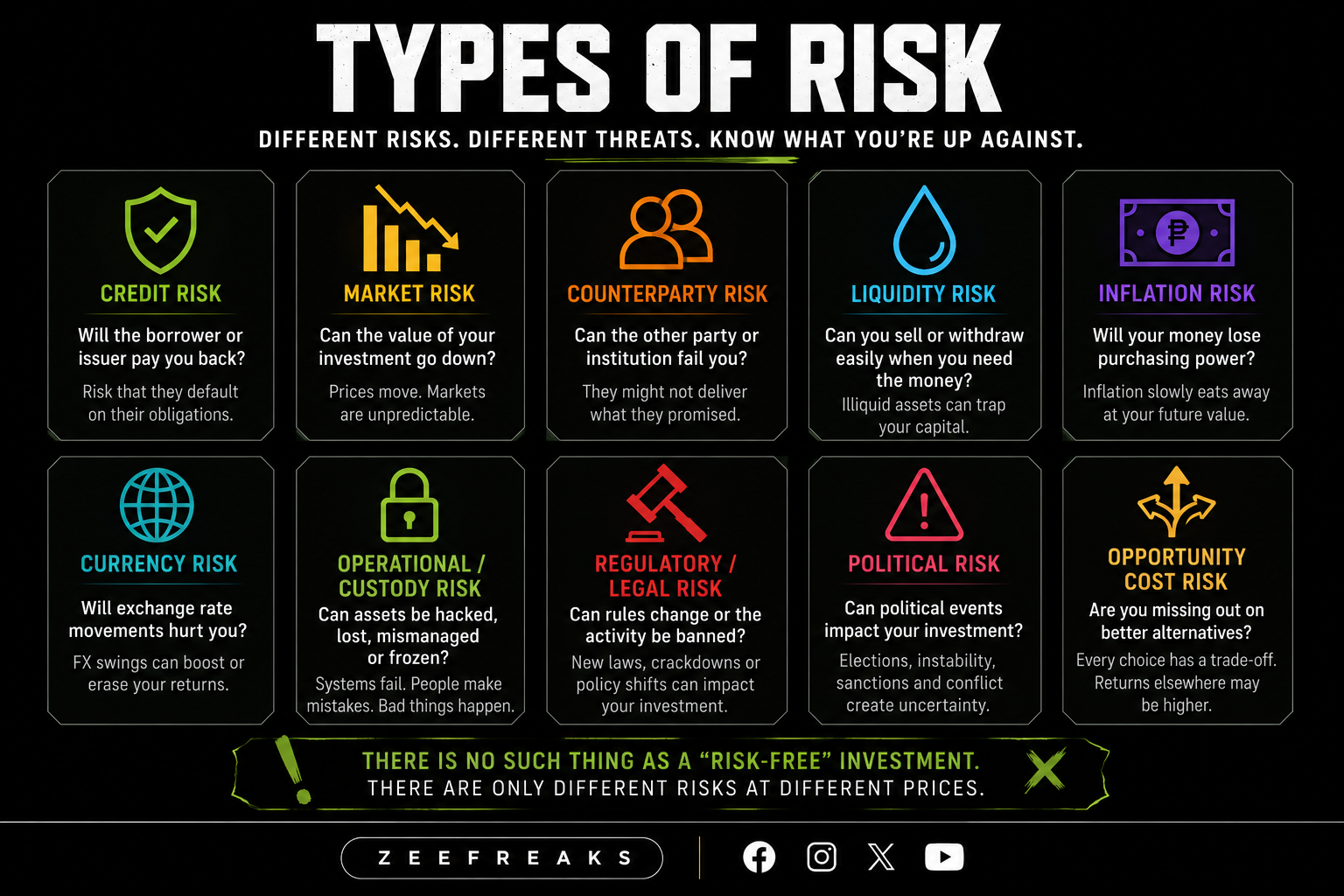
You have different kinds of risk:
Credit risk
Will whoever owes you money actually repay you?
Market risk
Can the asset price collapse?
Counterparty risk
Can the institution holding your assets fail?
Liquidity risk
Can you actually sell when you need the money?
Inflation risk
Will your money lose purchasing power?
Currency risk
Will exchange-rate movements destroy your return?
Operational/custody risk
Can assets be hacked, frozen, misplaced or mismanaged?
Regulatory/legal risk
Can the rules change or the activity be prohibited?
Opportunity cost risk
What better return, yield, or investment opportunity are you giving up by keeping your money here?
That's why saying:
“It's safe because it's regulated.”
is almost meaningless without specifying which risk you're talking about.
GOVERNMENT-REGULATED vs GOVERNMENT-BACKED
This is the easiest way to remember it:
REGULATED
Government says:
"You have to follow our rules."
INSURED / GUARANTEED
Government or another guarantor says:
"Under these specific conditions and limits, we'll cover the loss."
GOVERNMENT-BACKED DEBT
Government says:
"We owe you this money."
Three completely different statements.
And even the third one doesn't magically erase inflation, interest rates or purchasing-power risk.
Which brings me to something I keep repeating:
There is no such thing as “No-Risk.”
There are only different risks at different prices.
Cash feels safe because the number doesn't move much.
But inflation quietly attacks it.
Stocks look dangerous because prices move every day.
But productive companies can grow earnings over decades.
Crypto looks insane because...
Well...
Sometimes it actually is insane.

But even within crypto, Bitcoin, a diversified DeFi lending position and some random token called ElonBabyPepe420 should obviously not be placed in the same risk bucket.
The objective isn't to eliminate risk.
You can't.
The objective is to understand:
What can hurt me?
How badly can it hurt me?
What am I being paid for taking that risk?
And most importantly:
If I'm wrong, do I survive?
Because that's the part most people don't factor.
You don't need every investment to be “safe.”
You need your portfolio to survive when one of your supposedly safe investments turns out not to be.
That's risk management.
Everything else is marketing with nicer vocabulary.